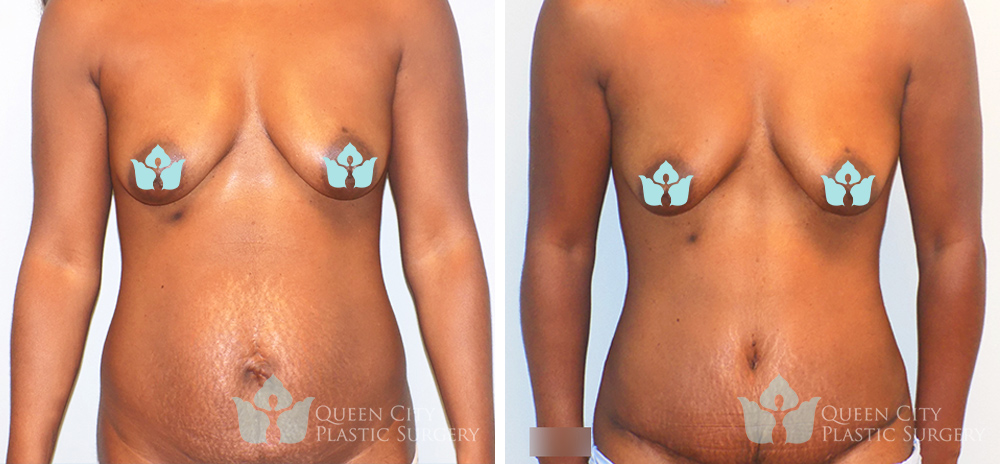
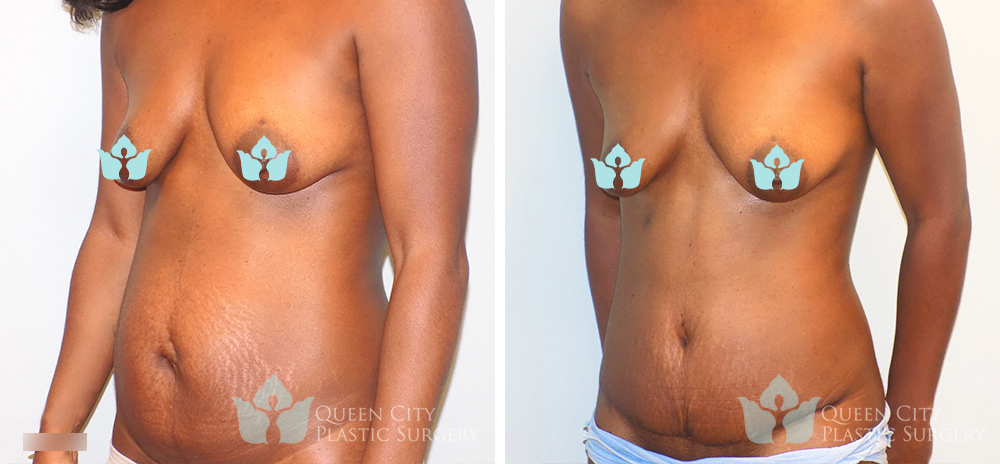
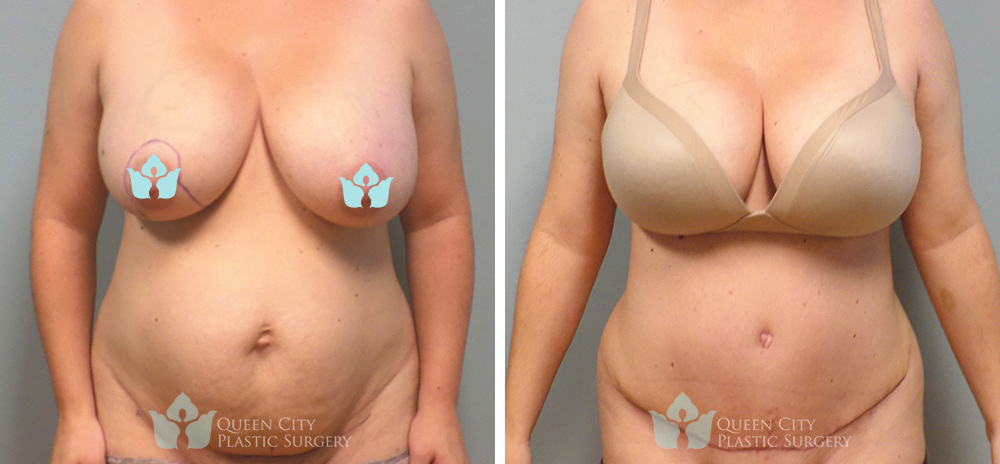
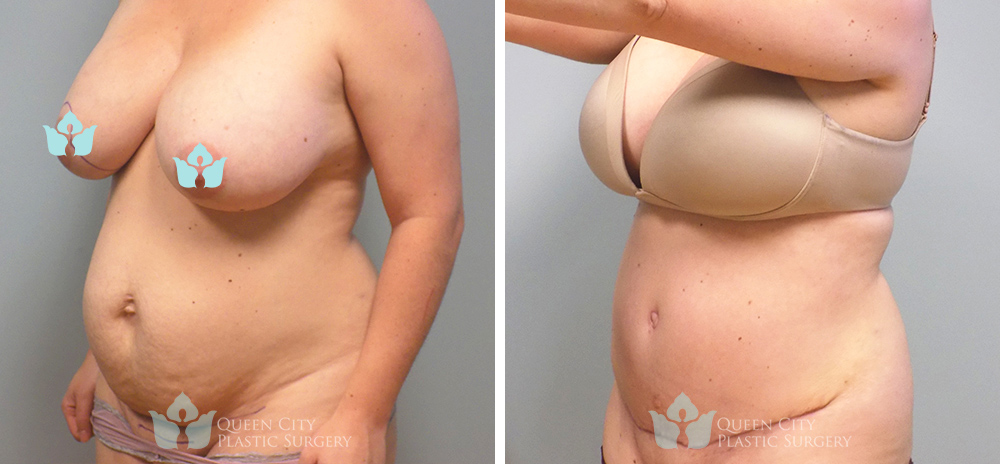
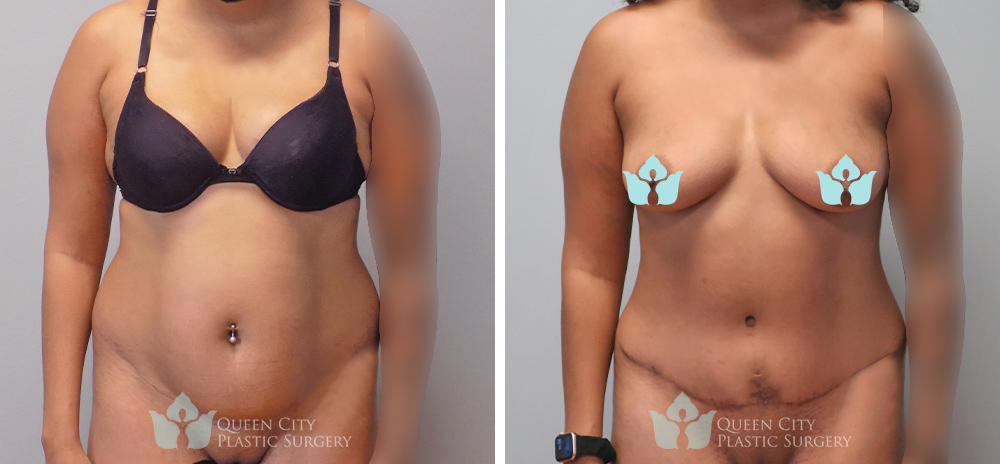
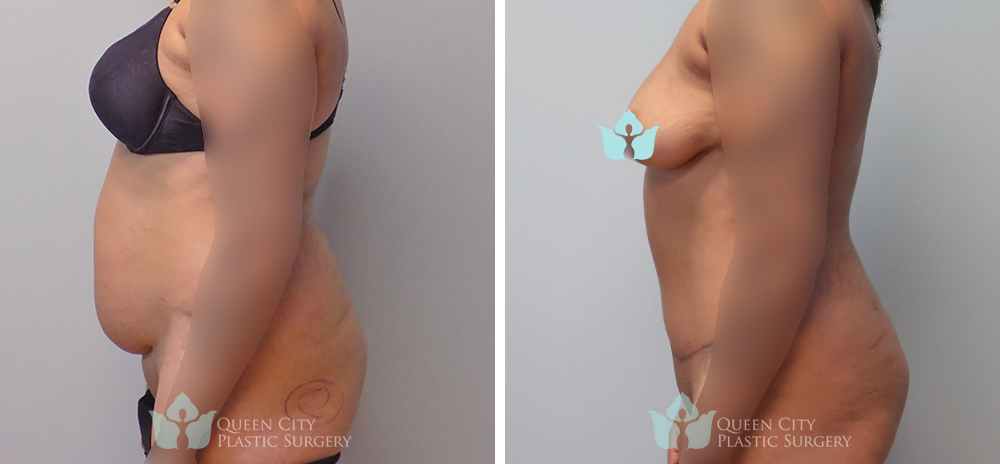
Real Patient Results
If you have had breast implants for several years, you may eventually wonder: Do my breast implants need to be replaced?
Perhaps your breasts look or feel different than they once did. One implant may seem higher or lower, your breasts may feel firmer, or you may simply be wondering whether your implants are getting too old.
The good news is that breast implants do not automatically need to be replaced every 10 years. There is no expiration date that requires routine replacement of an otherwise satisfactory implant. However, breast implants are not considered lifetime devices, and the likelihood of developing an implant-related complication increases over time.
At Queen City Plastic Surgery in Charlotte, NC, board-certified plastic surgeon Dr. Enam Haque evaluates patients with older breast implants to determine whether their implants can simply continue to be monitored or whether breast implant revision, replacement, or removal should be considered.
No. One of the most common misconceptions about breast augmentation is that breast implants must be replaced every 10 years.
There is no rule requiring breast implants to be replaced simply because they reach their 10-year anniversary.
Some patients may have implants for many years without developing a problem. Others may require revision sooner because of implant rupture, capsular contracture, implant displacement, changes in their breast tissue, or a desire for a different appearance.
Instead of focusing only on the age of an implant, Dr. Haque evaluates several factors, including:
If your implants are intact, comfortable, and producing a result you still enjoy, replacement may not be necessary simply because a certain number of years has passed.
There is no way to predict exactly how long an individual breast implant will last.
Breast implants are durable medical devices, but they are not considered lifetime devices. As implants age, the possibility of complications such as rupture, capsular contracture, or the need for another operation increases.
This is why long-term follow-up is important even when your breasts look and feel normal.
For many patients, the more useful question is not, “How old are my implants?” but rather, “Are my implants intact, and am I still happy with my breasts?”
Changes in your breasts do not necessarily mean your implants need to be replaced. Aging, pregnancy, breastfeeding, weight changes, and changes in the skin and breast tissue can all affect the appearance of augmented breasts.
However, you should consider an evaluation if you notice:
You may also choose breast implant revision even when there is nothing medically wrong with your implants. Your aesthetic preferences at age 45 may simply be different from the preferences you had when you underwent breast augmentation at age 25 or 30.
The signs of rupture depend partly on whether you have saline or silicone breast implants.
When a saline implant ruptures, the saline is absorbed by the body and the affected breast typically becomes noticeably smaller as the implant deflates.
This often makes a saline rupture relatively easy to recognize.
A silicone implant rupture can be more difficult to detect. Some silicone implant ruptures cause changes in breast shape, firmness, tenderness, swelling, or other symptoms.
However, a silicone rupture can also be silent, meaning neither the patient nor the surgeon can reliably identify the rupture through appearance or physical examination alone.
For patients with silicone gel-filled implants who have no symptoms, current FDA recommendations call for the first ultrasound or MRI approximately 5–6 years after implant placement and every 2–3 years thereafter.
If you develop symptoms or imaging findings are uncertain, additional evaluation may be recommended.
Whenever a breast implant is placed, the body naturally forms a layer of scar tissue, called a capsule, around it.
In some patients, that capsule becomes abnormally tight. This condition is known as capsular contracture.
Capsular contracture can cause a breast to become increasingly firm, round, elevated, uncomfortable, or distorted. Severity varies considerably, and not every degree of capsular contracture requires surgery.
For patients with significant symptoms or breast distortion, revision surgery may involve replacing or removing the implant, adjusting the implant pocket, and removing part or all of the surrounding capsule when clinically appropriate.
The appropriate treatment depends on the patient’s symptoms, implant history, anatomy, and examination.
Breast implant revision does not always mean simply removing an old implant and putting in a new one.
Revision surgery is customized to the problem being treated.
Depending on your anatomy and goals, your options may include:
This is one reason an in-person evaluation can be particularly helpful. Sometimes the implant itself is not the primary problem. Changes in the skin and natural breast tissue may be responsible for changes in breast appearance.
Not necessarily.
Some patients can undergo implant exchange alone. Other patients have developed enough skin laxity or breast sagging that simply replacing the implants will not adequately correct the shape of the breast.
A breast lift, or mastopexy, may be considered when there is significant sagging, stretched breast skin, or a low nipple position.
Combining a breast lift with implant revision can allow Dr. Haque to address both breast volume and breast shape rather than attempting to correct sagging simply by using a larger implant.
During your consultation, Dr. Haque can determine whether implant replacement alone or implant revision combined with a breast lift is more appropriate for your anatomy and goals.
Yes.
Some women decide that they no longer want breast implants and prefer to have them removed rather than exchanged.
The appearance of the breast after implant removal depends on several factors, including:
Some patients may be satisfied with implant removal alone. Others may benefit from combining implant removal with a breast lift to reshape and support the remaining natural breast tissue.
The surrounding implant capsule does not automatically need to be completely removed in every patient. Whether partial or complete capsulectomy is appropriate depends on the clinical circumstances.
Most changes associated with aging breast implants are not emergencies. However, certain symptoms deserve timely medical evaluation.
Contact a qualified plastic surgeon if you develop persistent new breast swelling, a new breast or underarm mass, significant pain, sudden implant deflation, or a substantial unexplained change in the shape of your breast.
A rare condition called breast implant-associated anaplastic large cell lymphoma (BIA-ALCL) has been associated primarily with textured-surface breast implants. BIA-ALCL is not breast cancer; it is a type of lymphoma that usually develops in the fluid or scar tissue surrounding the implant.
Persistent swelling, a mass, or pain around an implant—particularly when these symptoms develop years after surgery—should be evaluated.
Having older implants or previously having textured implants does not by itself mean that you have BIA-ALCL or that your implants automatically need to be removed. The appropriate approach depends on your implant history, symptoms, examination, and imaging when indicated.
No two breast implant revision procedures are exactly alike.
During surgery, Dr. Haque may remove the existing implants and carefully evaluate the implant pocket and surrounding capsule.
Depending on the reason for revision, surgery may involve:
Revision surgery is therefore planned around the individual patient’s anatomy rather than simply exchanging one implant for another.
Breast revision surgery can be more complex than primary breast augmentation because the surgeon must account for previous surgery, existing scar tissue, changes in the breast envelope, implant position, and the patient’s current goals.
Dr. Enam Haque is a board-certified plastic surgeon certified by the American Board of Plastic Surgery and has more than 15 years of experience in plastic surgery.
At Queen City Plastic Surgery, his approach to breast implant revision begins with determining why the breast has changed.
Is the implant the problem? Has the breast tissue changed around an otherwise intact implant? Is there capsular contracture or implant displacement? Would a breast lift provide a better result than simply placing a larger implant?
Answering these questions allows Dr. Haque to develop an individualized surgical plan designed to produce a balanced, natural-looking result.
If your breast implants are approaching 10, 15, or even 20 years old, their age alone does not necessarily mean they need to be replaced.
However, this may be a good time to have them evaluated—particularly if you have noticed changes in breast shape, firmness, symmetry, comfort, or implant position.
At Queen City Plastic Surgery in Charlotte, Dr. Haque can review your implant history, examine your breasts, discuss appropriate imaging when needed, and explain whether continued observation, implant replacement, implant removal, or another type of breast revision would best meet your needs.
If you are wondering, “Do I need to replace my breast implants?”, you do not have to make that decision based solely on how long you have had them.
A personalized evaluation can determine whether your implants appear healthy, whether additional imaging is appropriate, and whether revision surgery would actually benefit you.
Schedule a consultation with Dr. Enam Haque at Queen City Plastic Surgery in Charlotte, NC, to discuss your breast implants, any changes you have noticed, and your current aesthetic goals.
Whether the best recommendation is continued monitoring, implant replacement, breast implant removal, or a more comprehensive breast revision, the goal is to develop a plan appropriate for your anatomy, implant history, and desired outcome.
Real Patient Results